Holding History
Historical Irish documents and streetscape
Schools education resource

Home Rule to Civil War

1912–1923 — A decade that reshaped Ireland

A decade of revolution

Between 1912 and 1923, Ireland experienced a decade of political crisis, rebellion, war, partition, and civil conflict. The struggle over Home Rule transformed relationships across the island and between Ireland and Britain.

From the signing of the Ulster Covenant and the formation of rival volunteer forces to the Easter Rising, the War of Independence, the Treaty, and the Civil War, this period left a legacy that still shapes Ireland today.

Our school talks approach this complex history with care, balance, and respect for the different communities and perspectives involved.

Key moments, 1912–1923

📜

1912–1914 — The Home Rule Crisis

1912–1914

The Third Home Rule Bill promises limited self-government for Ireland. Unionists oppose it, signing the Ulster Covenant and forming the Ulster Volunteer Force. Nationalists respond by forming the Irish Volunteers. By 1914, Ireland stands on the brink of conflict.

⚔️

1916–1921 — Revolution and independence

1916–1921

The Easter Rising of 1916 changes public opinion after its leaders are executed. Sinn Féin wins the 1918 election, the Dáil declares independence, and the Irish Republican Army fights British forces in the War of Independence.

🤝

1921–1923 — Treaty, partition, and Civil War

1921–1923

The Anglo-Irish Treaty confirms the partition of Ireland. The Treaty divides former allies, leading to the Irish Civil War of 1922–23 and a painful new chapter in Irish history.

What we explore

Explore a complex period through evidence, discussion, and multiple perspectives.

What was Home Rule?

Students can explore what Home Rule meant, why many nationalists supported it, and why many unionists feared it. This provides a clear starting point for understanding the political crisis before the First World War.

The Ulster Covenant and volunteer forces

The signing of the Ulster Covenant in 1912 and the creation of the Ulster Volunteer Force were defining moments. Students can examine why people organised, how symbols and pledges were used, and how the Irish Volunteers emerged in response.

The Easter Rising

In Easter Week 1916, the Irish Volunteers seized key buildings in Dublin and proclaimed an Irish Republic. Students can explore the aims of the Rising, it's leaders, the Battle of Mount Street Bridge and an unusual daily truce...

The War of Independence

From 1919 to 1921, guerrilla warfare, policing, intelligence, and reprisals shaped daily life. Students can examine some of the weapons and equipment used by both sides of the conflict.

Partition and the Treaty

The Government of Ireland Act and the Anglo-Irish Treaty created new political arrangements. With Ireland partitioned, the scene is set for yet more conflict.

The Irish Civil War and its legacy

The Civil War divided families, communities, and former comrades. Students can examine why the Treaty split the independence movement and why the Civil War caused such resentment among former allies.

Artefacts we can show you

Holding History can use carefully selected original and replica objects, documents, and visual sources to help students investigate this complex period through evidence and discussion.

Documents and newspapers

original newspapers from the period including a copy of Saoirse na hÉeireann, written by members of the IRB

Weapons and ordnance

Various deactivated weapons and ordnance including original rifles imported by the UVF and a homemade IRA hand grenade.

Equipment and insignia

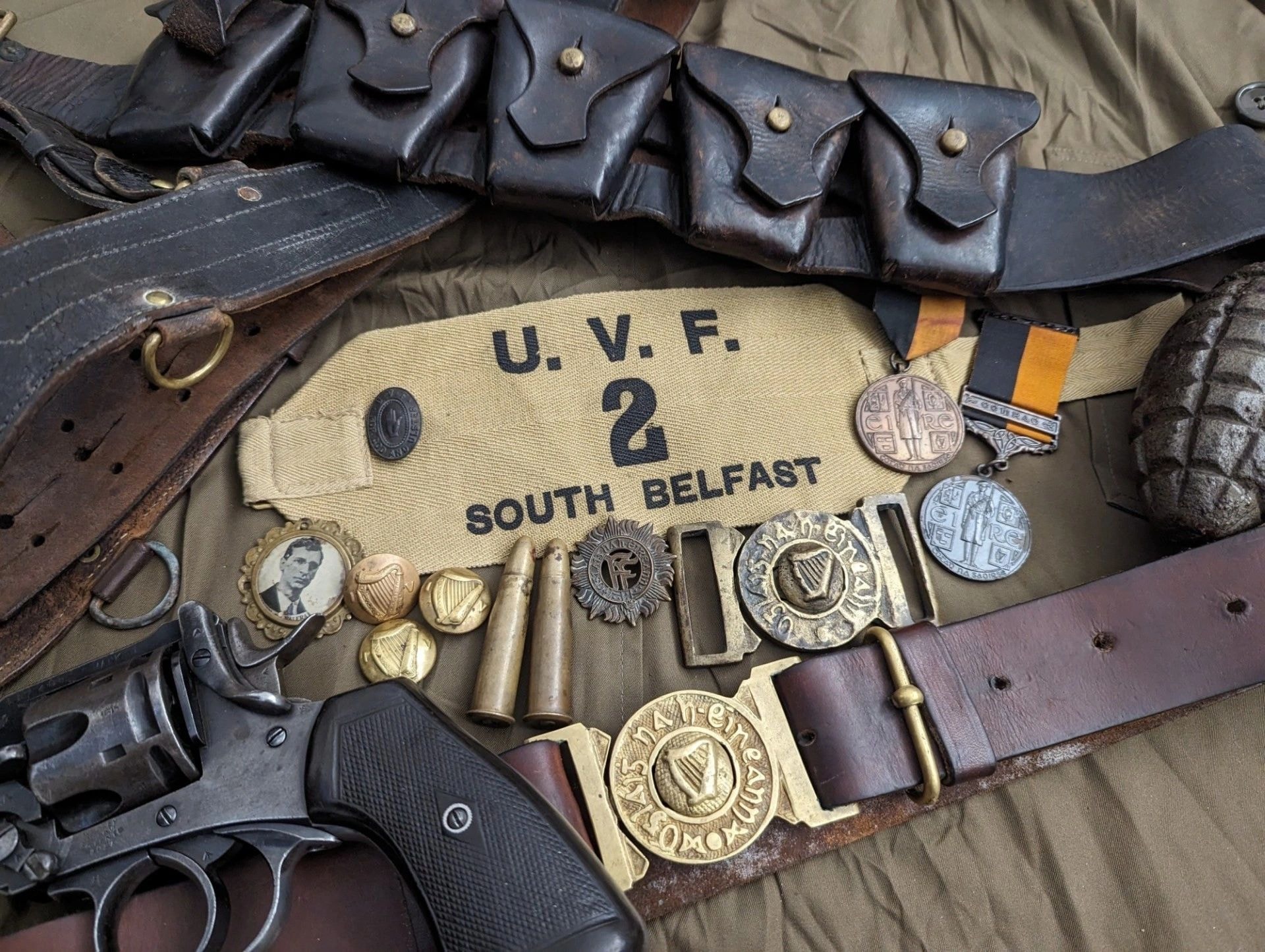
A UVF armband, Irish Volunteer buckles, cap badges and other equipment

Book a school talk

Bring this pivotal decade in Irish history into your classroom with a balanced, engaging, and age-appropriate talk.