The Troubles
1968–1998 — Thirty years of conflict
Understanding the Troubles
The Troubles was a conflict that lasted from the late 1960s until the signing of the Good Friday Agreement in 1998. Over 3,500 people were killed and tens of thousands were injured.
The conflict had deep roots in centuries of Irish history — questions of identity, sovereignty, civil rights, and religion.
This is a sensitive topic, particularly for those who lived through it. Our school talks approach it with care, balance, and respect for all communities, focusing on understanding rather than blame.
Key moments of the conflict
1968–1972 — The conflict begins
1968–1972
Civil rights marches demand equality for Catholics in housing, employment, and voting. Clashes with police and loyalists escalate. British troops are deployed in 1969. Internment without trial begins in 1971. Bloody Sunday — 30 January 1972 — sees 14 civilians shot dead by British paratroopers in Derry.
1972–1985 — The height of the conflict
1972–1985
Bombings and shootings by the IRA, loyalist paramilitaries, and security forces claim hundreds of lives each year. Bloody Friday, the Shankill Butchers, the hunger strikes of 1981, and the Brighton bomb mark this period. Communities on both sides live under constant fear.
1994–1998 — The peace process
1994–1998
The IRA and loyalist ceasefires of 1994 open the door to talks. Years of difficult negotiation, led by figures including John Hume, David Trimble, and US Senator George Mitchell, culminate in the Good Friday Agreement on 10 April 1998.
What we explore
Each topic is approached with sensitivity, balance, and respect for all communities.
What caused the Troubles?
The conflict had roots stretching back centuries — plantation, partition, discrimination, and competing national identities. Children can explore the long and short-term causes in an age-appropriate way, building historical thinking skills.
The Security Forces
Examine the roles of the RUC, B Specials, British Army and UDR. Students will be able to handle original equipment such as riot gear, and learn how and why it continued to develop over the conflict
The civil rights movement
Inspired by the American civil rights movement, people marched for equal rights in the late 1960s.Students can examine the demands, the marches, and how things began to spiral
The Paramilitaries
Who were the varios Republican and Loyalist paramilitary groups and how/why were they formed? Students will also look at the types of weapons used by these groups and where they came from.
The Good Friday Agreement
How do you end a conflict that has lasted 30 years? The Good Friday Agreement of 1998 is a remarkable example of compromise and peace-making. Students can explore what was agreed, who was involved, and what it means today.
The prisons and internment
Internment without trial, prisoners, escapes and the hunger strikes form a crucial part of the story of the Troubles. Students can explore the impact of this and examine prison art made by Republican and Loyalist prsioners.
Artefacts we can show you
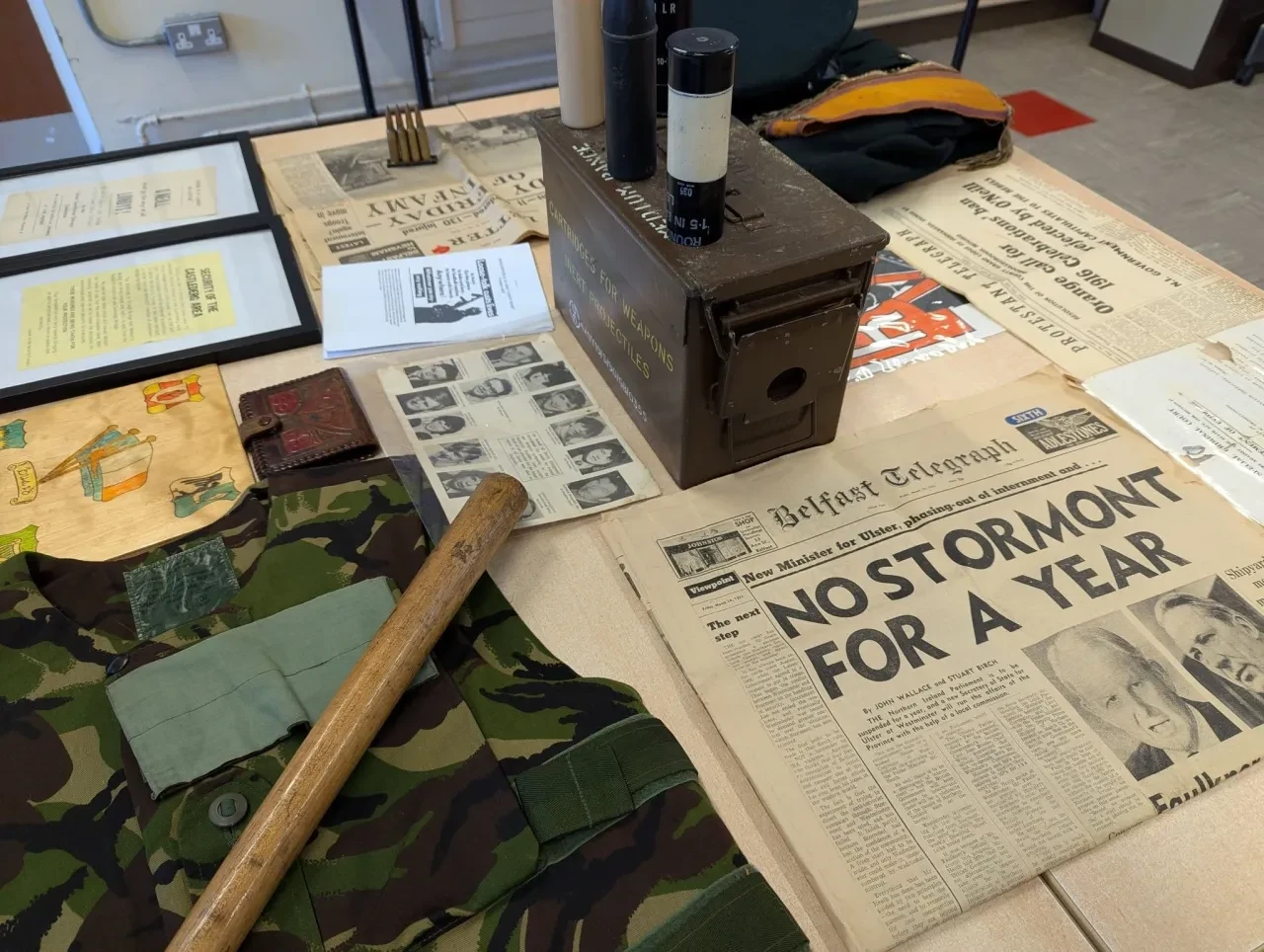
Holding History has a unique collection of original artefacts from the Troubles period, handled with sensitivity and care. These objects help students connect with the human reality of the conflict in a way that textbooks cannot.
Security force equipment
Original RUC and British Army uniforms, helmets, baton rounds and personal kit from the Troubles period
Paramilitary items
Carefully curated items relating to paramilitary organisations on both sides, presented in historical context including prison art and the types of weapons used
Newspapers and documents
Original documents and papers including An Phoblacht, The Protestant Telegraph, The Irish News and The Newsletter.
British army Land Rover
The star item of the Troubles talk. An original armoured Land Rover Snatch which was used in Belfast during the 90s
Book a school talk
The Troubles is a vital part of Northern Ireland's story. Get in touch to discuss a sensitive, balanced, and engaging talk for your school.